
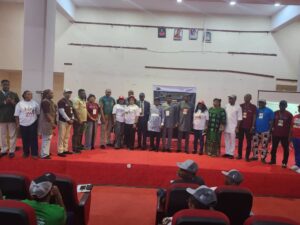
The Abia State Ministry of Environment, in collaboration with the United Kingdom Foreign, Commonwealth and Development Office (UK FCDO-PACE), has organised a two-day capacity-building workshop aimed at translating Nigeria’s Nationally Determined Contributions (NDC 3.0) into practical subnational actions, bankable climate investments and green growth opportunities in Abia State.
The workshop, designed for representatives of Ministries, Departments and Agencies (MDAs) and Local Government Areas (LGAs), is themed “Translating Nigeria’s NDC 3.0 into Subnational Actions, Bankable Climate Investment and Green Growth Opportunities in Abia State.”
The event, which commenced on Tuesday, November 3, 2026, and is scheduled to conclude on Wednesday, November 4, 2026, is holding at the JAAC Building, Abia State Secretariat, Umuahia.
In his keynote address, the Honourable Commissioner for Environment, Mr. Philemon Asonye Ogbonna, while welcoming participants and stakeholders, described the NDC 3.0 as an important framework for coordinating voluntary actions towards addressing the negative effects of the climate-related crises confronting communities and nations.
Mr. Ogbonna explained that Abia State, under the visionary leadership of Governor Alex Chioma Otti, has demonstrated commitment to environmental sustainability through deliberate policies, programmes and practical interventions aimed at tackling climate change.
He disclosed that the State had embarked on sustainable waste management initiatives to address waste generation and greenhouse gas emissions, while also implementing more than 14 erosion and climate adaptation projects across the State, with additional projects ongoing.
The Commissioner further revealed that the State Government had committed the sum of ₦1 billion as counterpart funding to re-energise the climate adaptation activities of the Abia State Nigeria Erosion and Watershed Management Project (ABIA-NEWMAP).
According to him, the implementation of NDC 3.0 presents Abia State with an opportunity to accelerate sustainable development and industrialisation, promote green job creation, attract climate finance and strengthen the capacity of communities to adapt to the growing challenges of climate change.
He noted that the framework would also help position the State to mobilise resources, strengthen institutional collaboration and integrate climate considerations into its long-term development agenda, including the proposed 25-year development plan.
Mr. Ogbonna therefore called on participants, particularly MDAs and LGAs, to see climate action as a collective responsibility requiring coordinated planning, effective implementation, accountability and sustained commitment.
He urged stakeholders to move beyond discussions and translate the objectives of NDC 3.0 into actionable programmes and projects capable of attracting climate investment, creating economic opportunities and improving the lives of the people.
In his presentation, the National Team Lead of FCDO-PACE, Mr. Ifeanyi Peters Ugwuoke, emphasised the importance of translating Nigeria’s NDC 3.0 commitments into practical actions at the state and local government levels.
He explained that NDC 3.0 provides an opportunity for subnational governments to take ownership of climate action by identifying priority sectors, strengthening institutional capacity and developing projects that can attract sustainable financing.
Mr. Ugwuoke noted that climate change should not be viewed solely as an environmental challenge but also as an opportunity to stimulate economic growth, encourage innovation, create employment and attract both public and private-sector investments.
He stressed the need for effective coordination among government institutions, development partners, the private sector and other relevant stakeholders to ensure that climate commitments produce measurable results.
He further encouraged participants to identify bankable climate projects, integrate climate considerations into their respective institutional plans and budgets, and develop strategies that would support Abia State’s transition towards a resilient, low-carbon and green economy.
The workshop also featured goodwill messages from relevant stakeholders, who commended the Abia State Government and UK FCDO-PACE for providing a platform to deepen understanding of climate governance and strengthen subnational participation in the implementation of Nigeria’s climate commitments.
A major highlight of the workshop was a panel discussion featuring targeted questions and answers, providing participants with the opportunity to exchange ideas, clarify issues and explore practical approaches to implementing NDC 3.0 across ministries, departments, agencies and local government areas.
Participants were also exposed to discussions on climate investment opportunities, institutional coordination, climate financing, adaptation and mitigation strategies, as well as the integration of climate actions into government policies, programmes and development plans.
Present at the workshop were technical officers from FCDO-PACE; Principal Secretary to the Governor/ Chief Strategy officer to the Government Mr. Chinenye Mbauzoukwu, the Permanent Secretary, Ministry of Environment, Mr. Ikechukwu Chidozie Oriuwa; Permanent Secretary, Ministry of Budget and Planning, Lady Meg Kalu; Permanent Secretary, Ministry of Finance, Mrs. Elechi Chianakwalam; former Vice-Chancellor of Alex Ekwueme Federal University, Prof. Chinedu Nwajiuba; Project Coordinator, NEWMAP, Dr. Nkiruka Chidia Maduekwe; SSA to the Governor on Environment, Prof. Ijeoma Iheukwumere; SA to the Governor on Climate Change and Sustainability, Ms. Esther Chioma Aja; Director of Climate Change, Ministry of Environment, Mr. Chris Ike, alongside other relevant stakeholders.
By: Obioma Chidinma Success
Ministry of Environment
Leave a comment